Thursday, March 12, 2015

Symbiotic, Parasitic and Parasitoidal Cycles of Finance


Part of my big macro economic piece (posted here) planted blame for the 2008 Financial crisis squarely at the feet of the financial industry. The is the very same industry that I've worked in every day since I graduated from University in 1993 with a degree in Economics (hey, don't laugh..).

I started working as an investment advisor at a bank owned brokerage firm, one of the big four, and as crazy and stressful as it was, I wouldn't change the experience for anything in the world as it really helped open my eyes to how the system worked and where the REAL incentives lay.

From my perspective, seeing first hand how the bank culture took over the brokerage side was a fantastic experience and the lessons I learned there helped me refine my instincts and skills as a money manager.

Now - if you've been reading this blog at all you will know that I am absolutely NOT an economist nor an analyst. As such, most of the comments and observations I make here are usually rough, unscientific and lack the polish and eloquence provided by many of the other people who take time to share their thoughts on the markets and the economy. But I think what I lack in written eloquence, I make up for by having a keenly observant eye and an obsessive passion for figuring out what's going on.

So - with all of that stated, let me start my "point".

I have long used the analogy that the financial industry is much akin to a tape worm that is attached to the stomach of the global economy. As the economy grows, so does the tape worm and the tape worm's associated appetite. This mostly clumsy analogy suggests that there is a parasitic relationship shared between the financial industry and the global economy.

I would suggest that over history, finance and the global economy have experienced parasitic cycles that ebb and flow from one extreme to another. Those cycles could be broken down into three distinct classifications:

i) symbiotic
ii) classic parasitic
iii) parasitoidal

In a symbiotic relationship (which is not 'officially' parasitic, but bear with me) both the financial industry and the global economy benefit from the relationship. A simple but effective example from my own little retail investment world would be the creation and mass distribution (by the financial industry) of zero coupon, or "stripped" bonds. These things are fantastic for client accounts (RRSPs and RRIFs) as well as being a huge source of revenue for the financial industry.

In a classic parasitic relationship - only one party (the parasite) benefits, and at the expense of the "host".  You can take your pick here from a multitude of brutal parasitic financial plays, but to keep things simple let's just refer to the Goldman/Paulson/Abacus deal - Boo!

In this situation Goldman and Paulson did very well, while the buyers of Abacus (the hosts) got blasted.

Finally in a parasitoidal relationship - the parasite draws so much in the form of resources that it ends up either sterilizing or ultimately KILLING the host.

Again - take your pick, but for me the biggest (but as of yet 'unproven') example would be the plethora of debt instruments that have been made available to consumers. Each of these debt instruments draws a charge in the form of interest - that depletes the financial health of the host.

Sub prime mortgages, credit cards, lines of credit, 9 year car loans, car equity loans, Home equity loans, etc etc etc..

Again - if you read my larger macro piece, you know that I believe we hit 'peak debt' in 2007 and are now mired in a balance sheet recession of biblical proportions.

But, what I think the financial industry hasn't figured out is that all of these debts, all of the resources that they've drawn from their host (the consumer) has ended up KILLING them, or pushed them past the point of no return as we were motivated by profits and bonuses rather than fulfilling our fiduciary duties to provide SUITABLE financial advice to our clients.

This is why economists are always so flummoxed why the economy isn't bouncing back after 6 years of zero rates and unprecedented intervention and stimulus.

At best the host is now on life support in the ICU and is in a coma, and that's hardly a good thing.


Unfortunately for us, the financial parasite will never learn their lesson as they have sociopathic tendencies (as discussed here:  http://www.gubbmintcheese.blogspot.ca/2014/05/the-farmer-and-viper.html) and as such will never change or ease off in their thirst for more resources.

NB: Another great discussion of the status-quo parasitic/parasitoidal relationship between finance and the rest of the world can be found in Jesse Eisinger's outstanding piece here: http://mobile.nytimes.com/2015/03/05/business/dealbook/despite-changes-an-overhaul-of-wall-street-falls-short.html?referrer&_r=0

THIS is why I think the economy continues to struggle.

Now I know these points may sound a bit far off given my rambling, choppy writing style - but please, don't kill the messenger. For those who prefer glossy, professional, researched views look at what the BIS just wrote:
 

Call me crazy but I think this just confirmed by parasitic tie in.. (See what I mean? I can see it and write about it, but will leave it to other people to do a more thorough and eloquent job or researching and writing about it. )

So what to make of all this information?

Well first and foremost, I would take EVERYTHING that Wall Street says with a large grain of salt. Don't get me wrong, there are some very honest and amazing people who work in this industry.. not everyone is a bad guy or girl.

Unfortunately though, the incentives are hugely misaligned.. which means the little people who still believe in the fiduciary relationship with their investment people, are probably getting taken advantage of.

As Stephen King said, "Trust of the innocent is the Liar's most useful tool".

Keep that in mind when you are told that 'stocks are cheap' by people on the Street - even as the Shiller CAPE sits just below 28, a level only surpassed in 1929 and 2000...

Plainly put - we desperately need another Ferdinand Pecora, and we need him asap.

Great read here: http://en.wikipedia.org/wiki/Pecora_Commission

Unfortunately it appears as though government and regulators are still far too cozy with the financial industry to make any changes - which suggest we are (as of now) simply doomed to repeat yet another crisis.

I hope we can get this sorted out before another break comes, but it's certainly not looking great at this point.

Maybe tomorrow.

Cheers all.

Gubb


Wednesday, March 11, 2015

An observation from the front lines - commentary from a real estate agent in Vancouver

As I discussed on twitter - I received this email response from a client of mine after sending him a story about the Vancouver market. This was his reply.

(names removed for obvious reasons)

Hi Gubb,

Good article, I see it up close and personal every day.. I've been struggling to get a hold of business and it's becoming more difficult every month. The overall influence of the Asian buyer has become overwhelming. Home sellers almost universally believe it's necessary to hire an Asian realtor to get top dollar selling a home. Buyers are constantly having to go into multiple offer situations and are being out bid by Asian buyers willng to pay well over asking and assessed value. I've written offers on 4 properties in the last month - ALL were outbid, some by as much as 30% over asking 

70% of the for sale signs hopping up are with Asian realtors. The older, more well established realtors who dominated this market a few years ago are now fighting for listings and the back stabbing has begun. Up the street from my office the new home British Pacific Properties are selling new MODEST homes that start between $4m and $5m, and ALL of the buyers so far are from Mainland China who expect to come here once a year for a couple of weeks of holiday.

People are starting to speak out  but no one is doing anything. In Australia they have the same problem but their government's foreign investment review board has implemented new rules to stem the surge in home sales to foreigners. We need to do the same.

GUBB Comments below: 

My client then provided an example of a big recent home sale for $51,800,000

http://www.vancouversun.com/business/Priciest+Metro+Vancouver+homes+draw+buyers+from+China+with+video/10875651/story.html

Pretty amazing stuff. I do honestly think that the percentage of Vancouver sales with Mainland Chinese ties is FAR higher than 30%.. I'd be willing to suggest it's closer to 60%.. but of course no one really cares...  yet.

Cheers!

Gubb

Monday, December 29, 2014

2 day rallies - putting the Dec 16-18th return into context

How does this 2 day rally compare to the historical average?
The 2 day rally that started December 16th of this year seemed unusually robust and euphoric - rocketing from a low (close) of 1972.74 to a whopping 2061.23 by the 18th - that's 4.49%.

I had already been running a bit of numbers in response to the "Bullard rally" in October, so I tweaked things a bit to see if I could see the context of the Dec 16-18 move relative to other big rallies in the S&P 500 throughout history.

Now, a huge warning about this post and its findings - I do NOT have a Bloomberg terminal, so all of the data crunching I've done here has been by hand. Exporting the daily pricing data into an excel spreadsheet, calculating the 2 day returns, ranking them - etc. It's been fun, but there may be bone headed errors, even though I've tried my best to be as accurate as possible.

After ranking all of the 2 day rallies going back as far as I could (1928) - I found the Great Depression was providing way too much noise. So I thought I'd look at the data from January 2nd, 1940 to December 2014.

When I did that, some interesting things happened.

A - I found that the 4.49% rally we saw from December 16th to 18th was indeed noteworthy as it ranked as the 89th largest rally out of 18,853 2 day rallies in the data set. Not bad given a three sigma move is 5.05%.

B - I also noticed a tremendous cluster of similar dates on the other top rallies - 2008, 2000, 1998, 1973, 1982, etc

So, after ranking the top 100 2 day rallies back to 1940, I was able to categorize them into the following 12 events -

1. The 1987 Crash (Oct 19th, 1987)
2. The Sub-Prime Crisis
3. The Dot.com bubble
4. The 1973 - 1975 Recession
5. The 1981-82 Recession
6. The European Crisis of 2011
7. The 1990-91 Recession
8. The 1969-70 Recession
9. The Asian Flu
10. The LTCM Crisis
11. Various dates associated with war outbreaks
12. an "Unknown" classification - requires more research on the significance of each day

The date ranges I used for each particular crisis or event was the relative high as the start date, and the low as the end date. I did strip out the high market value reached before the Great Depression because the 31.86 high reached in 1929 wasn't recovered until 1954.

Doing this resulted in the following breakdown -


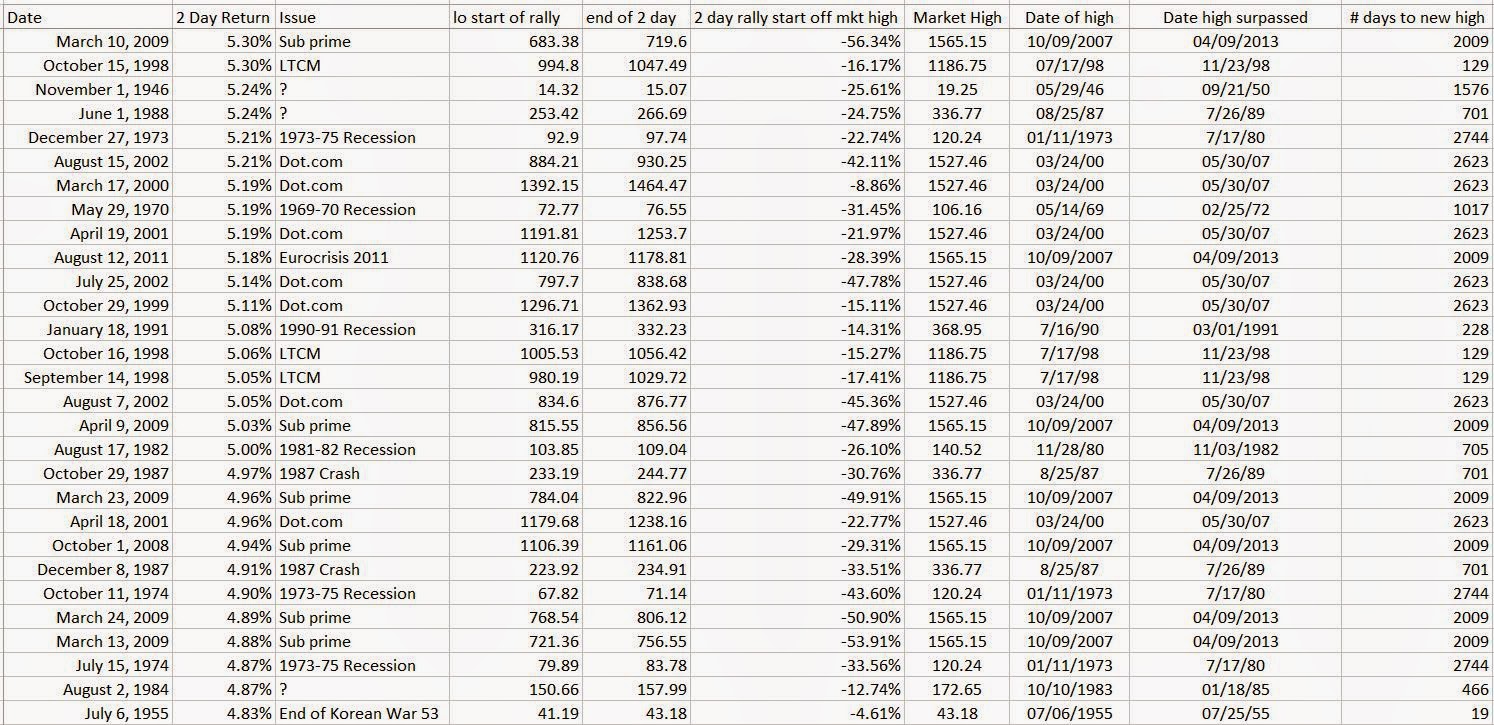
So, apart from the 14 days listed in the "unknown" category (which is more a function of me needing to do a bit more research than anything else) and the Dec 16-18th rally, 85% of the 2 day rallies between January 1940 and December 2014 occurred during a time of financial crisis, bubble chaos, recession or time of war. I found that very striking given the December 16-18th rally happened absent any of those markers. 

The other question I had about the history or tendencies of huge 2 day rallies related to how they compared to the previous high. My guess was that many (or most) of these unusually large 2 day rallies would occur after a significant correction or pullback from a previous high. SO once again I did a bit of digging through the data.

I found the larger (ie top 100 2 day rallies) occurred only after the markets had corrected on average by 30%. The smallest correction (3.59%) and outlier 2 day rally of  5.46% occurred in November 1982, during the 1980-81 recession. But, it took 705 days to surge past the previous market high. The December 16-18 4.49% rally occurred after a 4.95% correction but only took 7 days to surpass the previous record high. This is unusual given the average number of days to surpass the previous record high is 1637 days. 

While this breakdown doesn't provide any information that will help you with a trade, it does put the December 16-18 2 day rally of 4.49% into context. Given the rally occurred absent a recession, crisis, bubble or time of war - the magnitude of the rise is VERY unusual and should not be treated as 'normal' or "not noteworthy" - 

A breakdown of the top 100 2 day rallies is snapped below for your interest - again, given this was all done by hand, there may indeed be some errors.. but I've tried to be as thorough as possible. If you notice an error please let me know and I will update my spreadsheet. Or, if you are able to track down any of the "unknown" events let me know.. 


If you find this information useful GREAT!! If you reproduce it, post it, etc.. please do me a favor and provide attribution. I don't post much but it would be nice to get some credit if you find the material interesting.

Thx


Monday, December 8, 2014

McCulley, the Fed, rates and the ISM

I am a big fan of Paul McCulley and was a keen reader of his thoughts during his time at PIMCO (the first time around).

One of the best pieces I ever came across was entitled,


As you know I do a fair bit of bonds for my retail clients, so this piece was very interesting to me.. so - I set about to recreate Paul's work..

First, to make sure I had the right idea - I recreated Paul's graph from 1983 to 2005, just to make sure it looked similar. 


not bad.. 

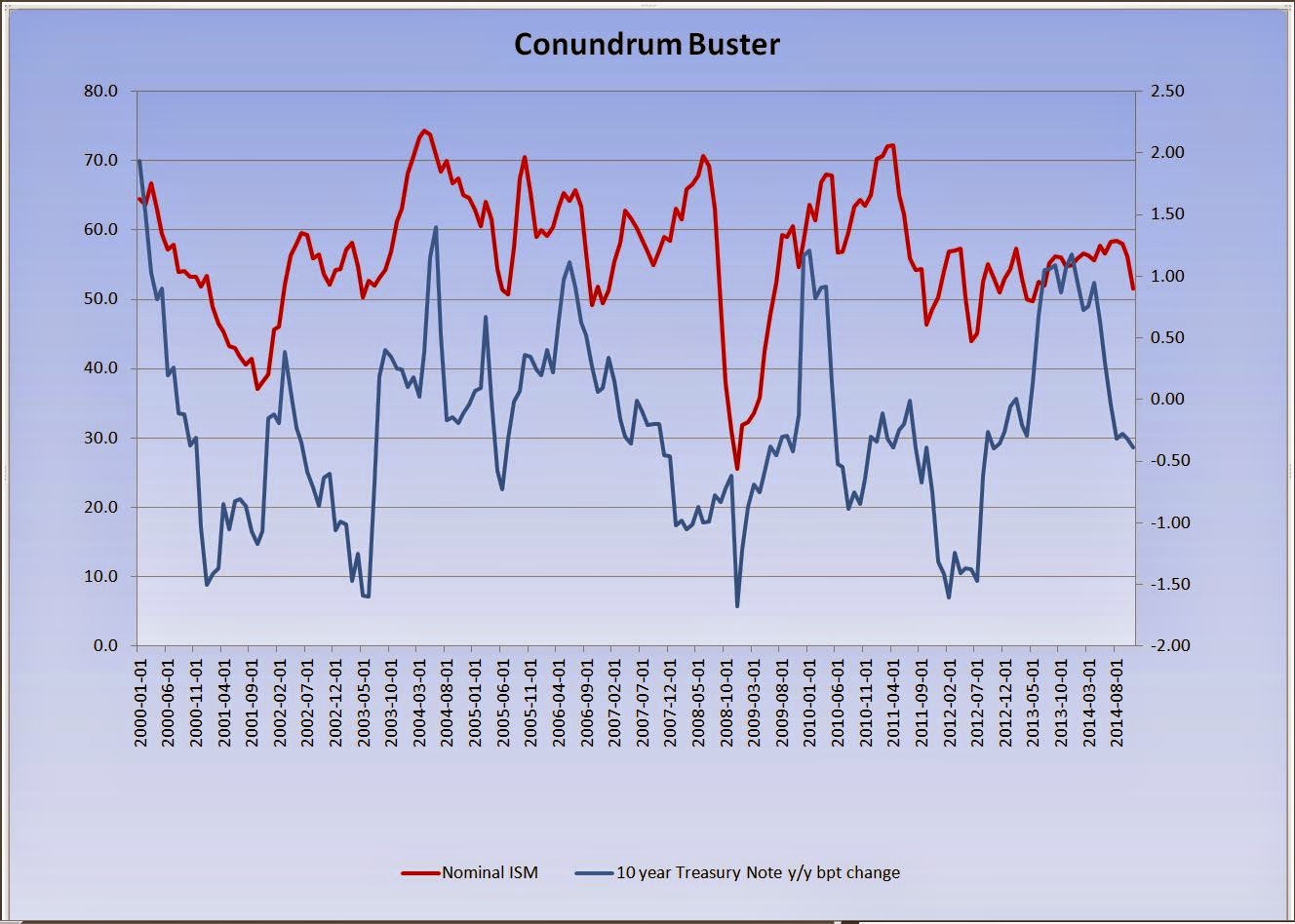
and then, I went off and applied the same set of rules to today's market. I've done this a few times (after the taper tantrum for example.. to check and see what I was missing) - 

here's where we are today - 


so to me, this continues to flash the "all clear" on rates. As such I don't think you will see rates rise because of fundamentals. We could however see a rate bump as per Gundlach's suggestions - but I doubt it would be much, or meaningful.. as the data just doesn't support a move higher at this point. 

Interesting stuff - 


Saturday, September 13, 2014

Excel Fun -

I'll say it until I am blue in the face.. I am NOT smart. I was never a kid who got A's in school, no matter how hard I tried or studied. I think one of my best qualities as a person who works in the financial industry is that I am very curious. I want to understand how things work to the best of my ability. While some are happy to just bob along like a cork in the big market, taking the returns that are given to them - that isn't okay with me. I want to UNDERSTAND the machine so that I have a very good idea of where these returns come from.

If you've been reading me here, or via my twitter account you know I have some major concerns about the market. To save time I won't rehash all of that here, but suffice it to say I don't think all is well out there.

Anyhow - John Hussman recently posted a fantastic chart that I think really put things into perspective - it was in his Weekly commentary from September 8th

here's the chart -


I've seen a lot of charts over the years, but nothing screams "umm.. what?" more than this one. But given my natural inquisitive nature.. I wanted to take a deeper look at this chart to see if there was anything noteworthy under the surface. I mean the run on the S&P 500 from 2009 to today 'could be' justified if earnings, incomes, jobs and GDP growth was running at all time highs. 

So I went to the best website on the planet for anything related to US macroeconomics FRED and pulled off the quarterly stats for GDP, Personal Consumption Expenditures and Corporate profits. I then hit Professor Shiller's website to snag the S&P 500 data along with the CAPE info.

Once it was all put into excel - I just created a base index using the respective starts of the bull markets to the nearest quarter (January 1995 to April 2000, January 2003 to October 2007 and April 2009 to present)
and came up with this (1995 bull for example).


I guess some will argue I should use different numbers, or a different base - or that GDP, PCE, EPS and CAPE figures don't matter.. and maybe that's true. It seems that economic fundamentals mean nothing these days.. but I have a very hard time thinking that they don't matter "anymore".

here's 2003-2007


and 2009 to 2014


Nothing screamingly obvious here.. but interesting to me none the less.

Here was the summary of each bull market's growth in the various components


and then I added it to Hussman's original chart..


It would be interesting to tear into the EPS data a bit more given the massive increase in share buybacks, and I'm sure there are all sorts of other data points that we could look at in addition to the ones I've picked here. I didn't try to cherry pick anything - instead just wanted to see if there was any major 'thing' that stood out. It does look like GDP and PCE are quite a bit lower than previous bull runs - but who knows.

Anyhow informative or not.. it was fun to play around here. I hope it inspires someone else to dig into this stuff in a bit more detail. Of course you know I tend to be leaning pretty significantly towards this market being a rather large bubble.. but obviously have no idea if or when it will pop. 

I guess time will tell. 


Monday, August 18, 2014

The Stockdale Paradox*


The Stockdale Paradox is named after Admiral James B. Stockdale, who was the highest ranking US Military officer imprisoned in Vietnam during the war. Stockdale was shot down while flying a mission over North Vietnam on September 9th, 1965 and taken immediately to the infamous Hoa Lo prison, also known as "The Hanoi Hilton". Stockdale was a "prisoner of war" and 'lived' there for the next seven and a half years.

In the summer of 1969, he was locked in leg irons in a bath stall and routinely tortured and beaten. When told by his captors that he was to be paraded in public, Stockdale slit his scalp with a razor to purposely disfigure himself so that his captors could not use him as propaganda. When they covered his head with a hat, he beat himself with a stool until his face was swollen beyond recognition. When Stockdale was discovered with information that could implicate his friends' "black activities", he slit his wrists so they could not torture him into confession. Stockdale was released as a prisoner of war on February 12, 1973

Year later, author James C. Collins was interviewing Stockdale about his time at the Hanoi Hilton for a book called "Good to Great" - during the interview, Stockdale explained how he managed to survive all those years as a POW. He said,

"I never lost faith in the end of the story, I never doubted not only that I would get out, but also that I would prevail in the end and turn the experience into the defining event of my life, which, in retrospect, I would not trade."

Collins followed up by asking Stockdale who didn't make it out of Vietnam alive. Stockdale replied,

"Oh, that's easy, the optimists. Oh, they were the ones who said, 'We're going to be out by Christmas.' And Christmas would come, and Christmas would go. Then they'd say, 'We're going to be out by Easter.' And Easter would come, and Easter would go. And then Thanksgiving, and then it would be Christmas again. And they died of a broken heart."

Stockdale then added, "This is a very important lesson. You must never confuse faith that you will prevail in the end—which you can never afford to lose—with the discipline to confront the most brutal facts of your current reality, whatever they might be."

 It was this philosophy of duality, that inspired Collins to describe it as the Stockdale Paradox.

Why am I writing about this rather dark and depressing paradox this month?

Well as I am sure you have figured out by now, I think it does a wonderful job of explaining how I am wired as a Portfolio Manager. While my letters over the years may sound dire and dark, the truth of the matter is that I have great hope and excitement about our future. I have faith that we will see through these difficult times, and get back to less chaotic days. But, as with Stockdale, I also possess the discipline to confront the most brutal facts of our current reality.

It was this discipline that enabled me (as you know) to completely avoid the dot.com bust in 2000, as well as the Great Financial Crisis of 2008/09, even as many in the industry ere busy assuring investors that "all was well" - .

(for example)
2008 recession? Not so fast: 

Ben Bernanke: No Housing Bubble in US -

Of course we know both of the statements above turned out to be spectacularly incorrect, and led to massive losses by investors.

Now, in 2014 the stock market has hit all time record highs as expectations that the US economy is approaching "escape velocity" - but, my discipline and macroeconomic research believes this is yet another naively optimistic narrative.

To borrow the paradox above, the US stock market has been saying they will see escape velocity by Thanksgiving, then Christmas, then New Years, then Easter.. Those of us who have been keeping track know that they've been saying this for the last 5 years.

Confronting the brutal facts about our current economic situation tells us that while things are certainly better than they were in January or February 2009, they are a very long ways away from anything that could be construed as "Escape velocity". As such, the longer true "escape velocity" eludes the US economy, the stock market as with those unfortunate souls who did not make it out of the Hanoi Hilton, run a massive risk of dying from a broken heart.

Just something to consider.

* a h/t to Zerohedge. While I was very familiar with the story of James Stockdale's torture, I had forgotten about the paradox - something they mentioned in two fantastic posts here and here. I wrote something similar not to try and pretend this was my original idea, but to record these thoughts on my own blog for future reference.

cheers


Friday, August 1, 2014

The industry is getting lazy...

I should preface this - and all of my posts for that matter - by saying that my scope and experience is purely on the retail advisory side. I've never worked in straight banking, nor on the institutional side and I don't have a CFA and am certainly NOT an equity analyst. I started straight out of University in 1993 and everything I know today I've picked up along the way.

I run individual investment portfolios - I manage the investments of your Mom or Dad, your Grandparents, or your Aunts and Uncles. I don't do futures or currencies and stick to running mostly vanilla stocks and bonds.

The more I read about how some people trade via twitter, the more I realize that my specific portion of the investment world is basically the phytoplankton of finance. We are small and individually insignificant but do play a big part in supporting the bigger financial ecosystem. Bigger players have other terms for us, "muppets" comes to mind.. which is fair enough, so call me Gonzo.

I will concede that perhaps the observations I make, as a small phyto-financial plankton don't mean a hill of beans to the bigger ecosystem. But if I do say so myself I think I have developed a bit of a knack for identifying problem areas before they occur.

Yes I admit it freely - I'm wired to worry.

I am more often than not inclined to take the safer road and the cautious approach than to seek out risk. Personally think you kind of need this mindset if you want to work in retail and manage "Other People's Money".

I mentioned the problem that I have with analysts getting "lazy" with their target prices and advice on stocks in "Charles Neuhauser meets the Asch Paradigm" - in today's market I am seeing a TON of target prices getting bumped up even as earnings estimates fall. Paying 24x next year's estimated earnings on a stock whose longer term eps growth rate averages 4 or 5% is just asking for trouble.. but, many ignore the rules.

AH well.

I'm seeing so many target prices being bumped up a few dollars via an expanded multiple assumption rather than any higher assumed earnings - just so analysts don't have to answer the question of why the stock isn't a sell.

It's that Keynesian career risk thing - you don't want to put a sell recommendation on a stock only to have it keep rolling higher on you.. client's don't dig that.

But you know what? An expensive stock is an expensive stock.. and call me naive but if you are simply slapping an additional 1.5x multiple on an ALREADY LOFTY forward PE.. just because the momentum of the stock continues to be higher.. what sort of value are you adding to the portfolio?

Also - given earnings growth and fundamentals are clearly NOT driving the share price.. how on earth are you going to know when to get the hell out of the way?

I find too many just accept the upside without paying too much attention to the fine print (or lack thereof).

Stock is moving through your target price? Well then take a look at your model and see if you are missing anything that could explain the action.. more growth coming from somewhere you didn't anticipate? Are your earnings expectations too conservative? But for god's sake don't just look at the street consensus and slap another 1.5x on so you can increase your target price by $5.00..

Clients pay us a lot of money to work diligently on their behalf.. if a stock is expensive.. it's expensive.. if it has a target price of $50.00 and it's trading at $56.00 with no new catalysts to push your earnings estimates higher.. you need to at LEAST do the math to see if you should ease the size of the position down.

If I'm running my own funds then it doesn't matter - but the last thing in the world you want to do is be overly optimistic on a stock or market with client money..

Most in retail tend to be fairly heavy in equity anyhow (some I know are basically 100% in stock.. holy crap..) - so if they are WRONG on the recovery and the bull market.. they don't get hurt.. but man, do the clients get smoked.

Just a small rant.. I saw about four 'increased target prices' using the same cheeky pe expansion (even as estimated earnings were REDUCED!!!)

Somewhere, Charles Neuhauser is shaking his head and waiting to say

"I told you so..."

be safe out there people.. :)


Gubb